Every Restaurant in Qatar Will Have a Public Food Safety Rating: Is Yours Ready?
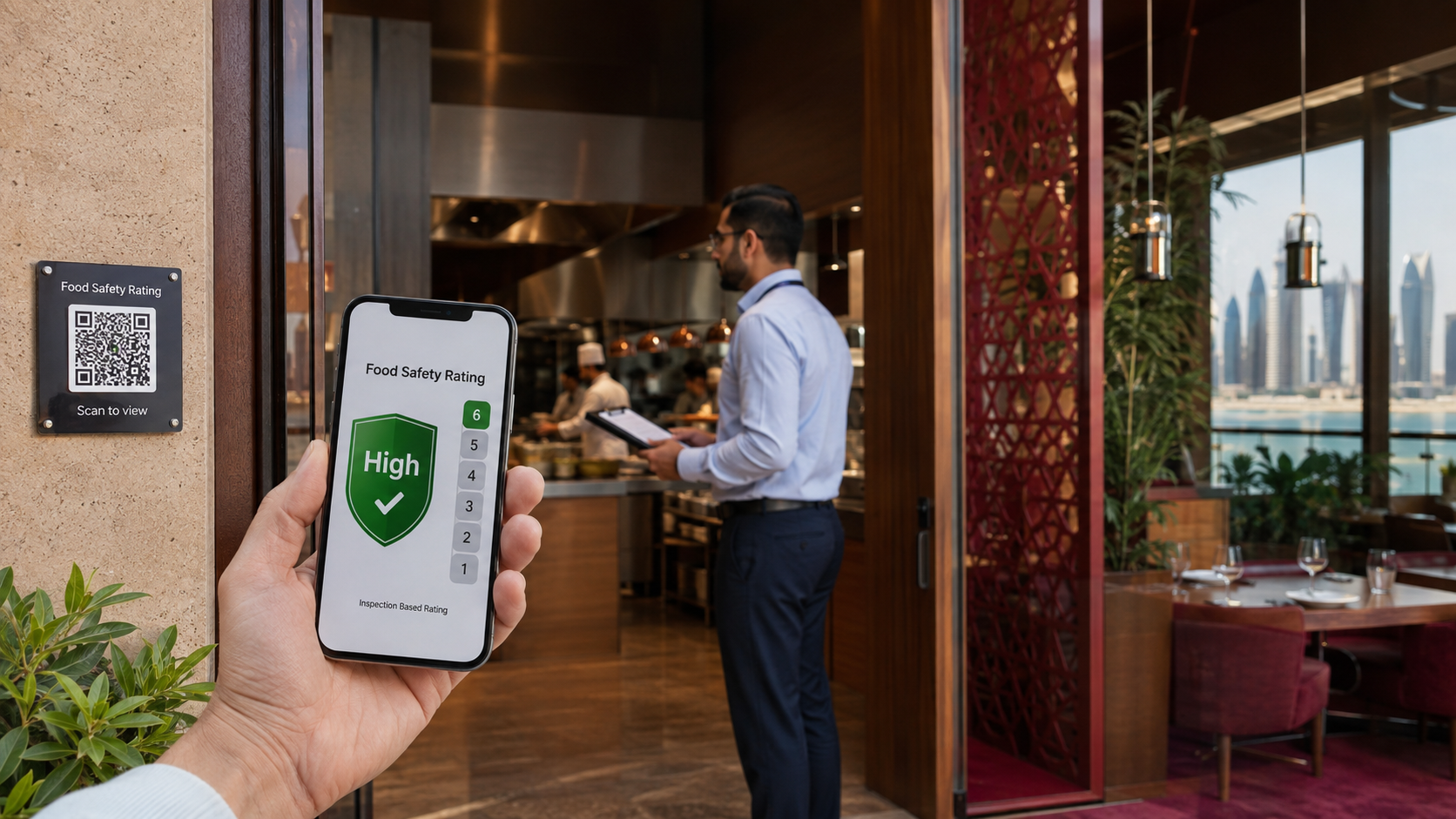
Before choosing a restaurant in Qatar, most of us check Google reviews, menu, prices or maybe Instagram photos.
But have you ever checked the restaurant’s official food safety rating?
Now you can.
The Ministry of Public Health in Qatar has introduced the Food Safety Rating Programme through the Watheq system.
The inspection rating of restaurants and other food establishments can now be viewed by the public. You don’t need to own the restaurant, work there or even create an account.
You can search by restaurant name, municipality, area or type of establishment. If you allow location access, the system can also show food businesses close to your current location.
You can check restaurant ratings from the official link below:
Qatar Food Safety Rating Search – Watheq

Up to this point, it may sound like a system that mainly concerns customers.
Actually, the bigger issue starts for restaurant owners and operators.
When you search through the Watheq platform, you will notice that many restaurants are still waiting for evaluation. Their rating has not been published yet.
This does not mean that these restaurants are outside the programme. Most probably, their inspection and evaluation turn has simply not arrived yet.
The programme is expanding to all restaurants
The Food Safety Rating Programme was first introduced for hotels, restaurants in tourist areas and food establishments operating inside shopping malls.
The third phase expanded the programme to cover other restaurants and food establishments providing food directly to consumers across Qatar.
As of February 2025, the Ministry announced that 1,284 food establishments had already been classified. Today, when you search the system, you can still see many restaurants waiting to be evaluated.
So, the simple message for restaurant operators is this:
Your restaurant’s turn will also come.
And the result will not be a private technical report staying between the restaurant and the authorities.
Your customers can see it. Your competitors can see it. Your landlords, corporate clients, investors and potential business partners may also see it.
This means food safety inspection is no longer only about avoiding a fine or closure. It is becoming a public performance indicator that can directly affect customer trust and the value of your brand.
How are restaurants rated?
Under the Watheq Food Safety Rating Programme, establishments are placed into one of six categories:
- Urgent Improvement Necessary
- Major Improvement Necessary
- Improvement Necessary
- Good
- Very Good
- Excellent
It is not difficult to guess how a customer may react when choosing between a restaurant rated “Excellent” and another restaurant rated “Urgent Improvement Necessary.”
The risk is not only receiving a low rating. A customer can take a screenshot of that result and share it on social media or in a WhatsApp group.
A poor rating can spread much faster than any official inspection report did in the past. On the other hand, a “Very Good” or “Excellent” rating can become a very strong marketing tool. Restaurants may display their rating at the premises, on their websites or across social media.
A strong rating tells customers that food safety is not only something written inside a company manual. It is part of the restaurant’s daily operation.
A clean-looking restaurant is not always inspection-ready

After spending many years in restaurant operations, one of the most common sentences I hear is:
“Our kitchen is clean. We will not have a problem during inspection.”
Of course, having a clean kitchen is essential. But a professional food safety inspection is not only about whether the floor looks clean or the employees are wearing proper uniforms.
An inspector may look at the entire operational flow, from receiving and storage to preparation, cooking, cooling, reheating and service. For example:
- Are refrigerator and freezer temperatures being checked regularly?
- Are the records genuine, or are they completed just before an inspection?
- Are raw and ready-to-eat products properly separated?
- Do opened products have opening and expiry dates?
- Can every product be traced back to an approved supplier?
- Are cleaning chemicals labelled and stored in a separate area?
- Do all food handlers have valid health certificates?
- Are pest control reports updated?
- Do employees really follow the procedures they were trained on?
- Is corrective action recorded when something goes wrong?
Sometimes a restaurant has written procedures, but employees do not follow them. Sometimes the team performs the work correctly, but there is no documention to prove it. And sometimes the entire food safety system stays inside the quality manager’s computer without becoming part of the real operation.
All three situations can create problems during an inspection.
You cannot prepare for this inspection one day before
Food safety is not a deep-cleaning activity that starts after hearing an inspector may visit. A good system has to work every day. It has to work on a busy Thursday night, when the restaurant is full and the team is under pressure. It has to work when an employee is absent. It has to work when the restaurant manager is not there.
The real quality of an operation does not appear on a quiet morning. It appears during the busiest shift, when people are tired and the kitchen is producing at full capacity.
This is why restaurants should start reviewing the following areas now.
1. Receiving and supplier control
Every product entering the restaurant should come from an approved supplier, in a suitable vehicle and at the correct temperature. Packaging should be intact. Labels should be clear, and the condition of the product should be checked before accepting it. If you accept a damaged, unlabelled or incorrectly transported product into your restaurant, you have already started losing control before the product reaches the kitchen. Receiving is the first real control point of a restaurant operation.
2. Temperature management
Refrigerator, freezer, cooking, hot-holding, cooling and reheating temperatures should not only be known. They should be measured, recorded and checked. Having a thermometer somewhere in the kitchen is not enough. It needs to work correctly, employees should know how to use it, and calibration should be completed when required. More importantly, management should monitor the records. If every refrigerator shows exactly the same perfect temperature every day, this may not always be a sign of an excellent operation. Sometimes it is a sign that nobody is really measuring it.
3. Prevention of cross-contamination
Raw meat, poultry and seafood should be properly separated from ready-to-eat food. This separation should be visible in storage, preparation areas, equipment and staff practices. Small details such as cutting-board colours, refrigerator layout, knife usage and employee handwashing can make a serious difference. A restaurant may buy the best-quality ingredients but still create a food safety risk through poor handling.
4. Labelling and shelf-life control
Every opened, prepared or transferred product should clearly show:
- What the product is
- When it was opened or prepared
- When it must be used or discarded
- Who prepared it, if required by the system
“The staff already knows” is not a food safety system. People forget. Employees change. Shifts change. The restaurant becomes busy. Clear labels remove unnecessary assumptions from the operation.
5. Employee health and food-handling practices
A valid health certificate is important, but it is not enough by itself. Employees should correctly apply handwashing, glove changing, personal hygiene and illness-reporting procedures. A staff member may have attended several training courses. What matters is whether the training can be seen in their daily working habits. Food safety training is successful only when behaviour changes inside the operation.
6. Cleaning and pest control
A cleaning schedule should clearly explain:
- Which area needs to be cleaned
- How often it should be cleaned
- Which chemical should be used
- Who is responsible
- Who verifies the result
Pest control is also not only about a company visiting the restaurant once a month and spraying chemicals. Building gaps, waste management, drainage, dry-storage organisation and any sign of pest activity should be monitored. If there is pest activity, the restaurant should not only treat the visible problem. The team should understand why it happened and how to prevent it from happening again.
7. Records and corrective actions
The purpose of keeping records is not to fill folders. Records should help the restaurant identify a problem before it becomes serious. For example, if a refrigerator is above the permitted temperature, it is not enough to write down the number. The record should also show:
- What happened to the products inside
- Whether their temperature was checked
- Whether they were transferred or discarded
- Whether the refrigerator was repaired
- What action was taken to prevent repetition
A temperature record without corrective action is only half of the job.
A low rating can cost more than a fine.
The cost of receiving a poor food safety rating is not limited to an official penalty. It may lead to:
- Loss of customer confidence
- Negative social media exposure
- Reinspection and corrective-action costs
- Product disposal
- Temporary suspension of operations
- Problems with landlords or shopping-mall management
- Loss of corporate catering clients
- Damage to investor confidence
- Time and motivation loss for the management team
- Difficulty expanding the brand into new locations
A restaurant may spend years building its reputation through good food and customer service. But one serious food safety failure can damage that trust very quickly. This is why the rating should not be considered only as a compliance subject. It should be considered as part of brand management, commercial risk and long-term operational sustainability.
Find your weaknesses before the inspector does In my opinion, restaurants should not wait for the official evaluation.
The operation should be assessed before the inspection takes place. The physical condition of the kitchen, product flow, employee practices, temperature controls, cleaning system, supplier traceability, training records and management follow-up should be reviewed together.
This is where a professional outside perspective becomes valuable. When people work inside the same restaurant for a long time, they can become familiar with incorrect practices.
A damaged surface is seen every day and slowly becomes normal. An incorrectly stored product becomes “the way we always do it.” A missing record becomes accepted because no serious incident has happened yet.
An experienced operations or food safety professional can usually identify these risks more clearly because they are looking at the restaurant without becoming used to its daily habits. The aim is not to hide something from the inspector.
The aim is to identify and correct the same problem before the inspector finds it. At Restoforge, we do not focus only on making a restaurant look good on inspection day.
We focus on building a practical and sustainable operating system that can continue during busy shifts, staff changes and management absence. Because food safety is not a certificate hanging on the wall. It is not a folder prepared for the authorities. It is not a last-minute cleaning operation.
Food safety is the daily operation itself. Today, the Watheq system may show that your restaurant is still waiting for evaluation. But it may not stay that way for long.
Before your restaurant’s turn arrives, are you really ready?
Sources